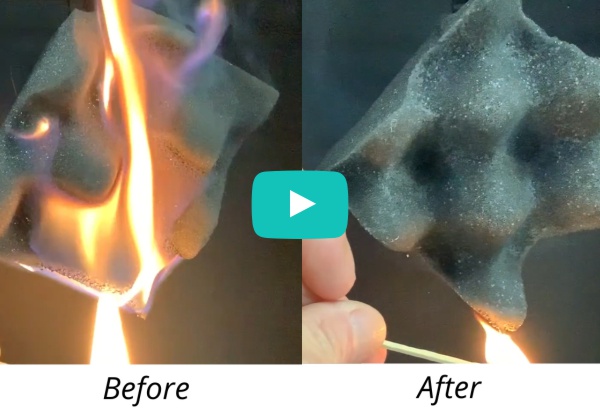
On-Site was recently asked to provide a briefing to the National State Fire Marshal’s Association regarding gaps in fire safety for textiles. There is a large gap between “looks fine” and “is code compliant” when it comes to soft goods such as drapes in public buildings. The integrity of the flame retardant on textiles forms an important part of a facilities fire protection system. There are over 1,000,000 regulated locations and over 300,000 assembly occupancies in North America with an estimated 85% of those in non-compliance.
Compliance Is Treated as a One-off Event. Fabric Is a Process.
Fire codes verify flame resistance once, usually at installation or renovation. A certificate is issued, filed, and forgotten. Nothing in the code triggers a second look.
Fabric is the only material which does not cooperate with that model. It is in constant state of evolution based on interaction with the environment around it:
Moisture. Textiles absorb and release humidity continuously, and topical flame retardant leaches out with it.
Dust. A drape acts like a giant air filter. It traps dust deep in the fabric fibres, this embedded dust is highly flammable and will eventually overwhelm the flame retardant. Important to note that dust affects Inherently Flame Retardant (IFR) materials as well as treated Flame Retardant (FR) materials.
Heat and UV. Stage lighting and daylight break down the flame retardant.
Oils and food odors. Oils from hands and food feed mould, mildew and bacteria, and those organisms consume fibres and treatment alike.
Cleaning. Topical flame retardant washes out. It has to be re-applied after any wash, and manufacturers specify the fabric has to be thoroughly cleaned first or the new treatment will not bond.
The end result is that a drape can look pristine, clean and undamaged while its flame retardant has degraded to unsafe levels.
Certificates issued more than 3 years ago do not provide any indication of current flammability.
Visual inspection or outdated certificates cannot confirm compliance. Only a test can.
The Historical Record: What We Are Preventing
The case studies are the ones we all learned: the Iroquois Theatre in 1903, where an arc light ignited stage curtains and 602 people died; Cocoanut Grove in 1942, 492 deaths from ignited fabric decor; the Station nightclub in 2003, where pyrotechnics lit acoustic foam and killed 100. You would think we would have learned.
Then 2026. Sparklers on champagne bottles ignited acoustic baffling at Le Constellation bar in Crans-Montana, Switzerland. Forty-one dead. Same ignition source category, same material failure, same dense assembly occupancy as West Warwick, twenty-three years later.
The Blind Spot Is Overhead, and It Is Not the Main Drape
If you take one item away from this briefing, take this one. Be mindful of the foam. Suspended acoustic foam, fabric ceiling treatments and sound-dampening panels fall under the same NFPA 701 or CAN/ULC-S109 and 705 requirements as stage drapery. In practice, they are almost never tested.
Black boxes, rehearsal halls, recording spaces, club rooms, multipurpose rooms with baffling added years later by a contractor nobody can now name, with nary a testing certificate in sight. Add open flame or pyro to the room and it becomes a high risk situation. Add to the list drapes and curtains: backdrops, netting, banners, flags, stage sets, artificial plants, upholstered items, wall coverings, tents, costumes, trade show displays, seasonal decor, and artwork covering more than twenty per cent of a wall.
Know Which Standard Is Which
Five numbers cover most of what an inspector will reference.
NFPA 101 is the Life Safety Code, the master reference. It requires flame-resistant materials in specified occupancies but sets no testing interval.
NFPA 701 is the lab certification for new fabrics. Destructive testing, typically conducted by manufacturer requires ten samples at roughly 4.9 by 47 inches, 120 seconds of flame exposure, self-extinguishing within two seconds, mass loss capped at 40 per cent. Method 1 covers most drapery, Method 2 the heavier and lined goods. This test is valid only on installation, due to environmental conditions, certificates over 3 years old should be re-tested with NFPA 705.
CAN/ULC-S109 is a destructive, laboratory-conducted test, and a material must pass both of its tests, not either one. The small-flame test exposes ten specimens of 90 by 250 mm to a 40 mm flame for twelve seconds, allowing an average damaged length of 165 mm and no single specimen over 190 mm. The large-flame test exposes folded and single-sheet specimens to a 280 mm flame for 120 seconds, limiting spread to 635 mm in folds and 250 mm in single sheets. Dripping residue must not flame beyond two seconds in either test.
NFPA 705 is the field flame test, simple to administer for fabric already installed. This test provides the best indication of current flammability. Non-destructive: a sample about half an inch by four inches, twelve seconds of flame. It fails if the sample flashes, burns for two seconds or more, or drips material that keeps burning.
NFPA 265 covers full-height textile wall treatments. Furniture sits under NFPA 260/261 and TB-117, and California adds TB-119 and Title 19 on top.
“Inherently Flame Retardant” Does Not Mean Permanent
Those selling drapery often provide assurance that IFR fabric is good for the life of the goods. That is simply not true.
IFR fabric has the retardant built into synthetic yarn at manufacture, so it will not wash out and it handles moisture far better than a topical treatment, which sits on the surface of natural fibre as a mineral barrier and is vulnerable to environmental loss.
But dust accumulation alone will overwhelm the flame retardant properties of the fabric and will make an IFR drape flammable and fail NFPA 705 testing. That is why both fabric types belong on a three-year professional cleaning cycle, with topically treated goods also needing re-treatment after every clean.
Nobody Is Overdue, Because the Code Never Says When
Here is the enforcement gap in one line. NFPA 101 section 10.3.6 requires that coatings be maintained to retain their effectiveness under service conditions encountered in actual use. IFC 803.4 and 807.1 say much the same and allow the authority having jurisdiction to field test under 705. In Canada, the Fire Code requires that flame retardant treatments on textiles “shall be renewed as often as required to ensure that the material will pass the match flame test in NFPA 705.”
None of that sets a frequency. None of it requires you to keep records. There is no registry, so no facility is technically overdue until it fails a test, and non-compliance stays invisible until there is a fire. Adoption varies by state and by code edition, and New York City is the only jurisdiction named as requiring annual testing plus mandatory three-year re-treatment.
The briefing’s estimates put live theatres and K-12 school stages at about 85 per cent. Whatever the true figures, if your building has no recent test on file, you are in that count.
A Schedule That Actually Works
Annually: run the NFPA 705 field test on installed soft goods, including acoustic treatment. Dust accumulation alone can turn last year’s pass into this year’s fail. It takes minutes per fabric type.
Every three years: professional cleaning for everything, with FR re-treatment for topically treated goods and non-immersion cleaning for inherent goods.
At change of custody: a full audit and re-test on a sale, a new operator, a new tenant or a management handover. This is where most non-compliance originates, because the paperwork rarely survives the transition.
What an Inspector Will Ask You For
Have this in a binder or a folder on the shared drive:
- The NFPA 701 or CAN/ULC-S109 in Canada certificates from the original installation. Any certificate older than three years should trigger a re-test.
- A 705 field test log: dates, pass or fail, who conducted it, which fabrics were sampled.
- Cleaning and FR re-treatment records with dates.
- The contractor’s identity, certification and product used, plus the certificate of compliance issued.
- A forward maintenance schedule.
The physical triggers that will draw attention: visible dust or soiling, missing certification tags, rips or unsewn hems, residential-grade drapes from a home-improvement retailer (never IFR), any suspended acoustic material, and seasonal or event fabric, which is almost always non-compliant.
Three Questions
The briefing closes with a decision tree that reduces the whole subject to this:
- Are the soft goods in an assembly or healthcare occupancy, or in an area of egress? If no, document the finding and move on.
- Is there NFPA 701 or CAN/ULC-S109 documentation less than three years old, with fabric that is neither visibly dirty nor ripped? If yes, accept it and close.
- If not, run the NFPA 705 field test. Pass, record the result. Fail, clean, re-treat and re-verify.
That is a fifteen-minute exercise for most venues, and it is the difference between believing your goods are compliant and knowing it. Ask when yours were last tested. If nobody can tell you, that is your answer.