Healthcare Curtain Sanitization & Documentation - Completed Outside Clinic Hours

Facility: Comprehensive Surgery Centre (Ambulatory Surgery / Outpatient Healthcare) - St. Petersburg, FL
Service Provider: On-Site Drapery Cleaners
Scope: Privacy-cubicle curtain cleaning & sanitization, minor repairs as required, maintenance program, NFPA testing coordination/re-certification support, flame-retardant application.
The Problem
A busy ambulatory surgery center needed privacy curtains in the main patient area restored to a hygienic, inspection-ready standard—without disrupting patient flow or clinical operations. Privacy curtains play a critical role in healthcare settings, providing a critical barrier against the spread of pathogens. Recent studies have found 90% of patient privacy curtains in healthcare environments harbored infectious diseases. Hospital style drapery is classified as a "high-touch surface," meaning it frequently comes into contact with the hands of patients, visitors, and staff. This increases the risk of cross-contamination. The key to mitigating this risk is regular cleaning. The Centre for Disease Control (CDC) has issued guidelines for sanitizing bedside curtains, recommending cleaning under the following circumstances: upon patient discharge, after any disease outbreak, and at least once per year.
Key Constraints
- Outside-hours execution only: Bedside drapes are critical to the operation of the surgery center. Work had to be completed outside clinic hours to avoid interfering with clinic operations.
- Infection-control risk: Privacy curtains are high-touch surfaces and need a defined cleaning schedule.
- Material protection: Traditional hospital laundry methods are not suitable for bed side curtains as heavy detergents and use of high heat in dryers cause the curtains to degrade prematurely. Sanitization methods used needed to avoid shrinkage, fading, or damage to the mesh, runners and hardware.
- Compliance documentation: The center required clear records for sanitization compliance review, including NFPA-related documentation.
What On-Site Delivered
1) Controlled Scope + Clinical-Aware Sequencing
- Confirmed inventory and work plan for 11 privacy-curtain panels in the main patient area
- Sequenced the work to match after-hours access rules and infection-prevention expectations
- Established annual Cubical Curtain Cleaning Program.
2) Healthcare-Friendly Execution Model
- On-site cleaning and sanitization method designed to effectively sanitize while protecting curtain components (mesh, runners and hardware) and preserving appearance
- Completed as a planned after-hours service call to keep clinical spaces operational
3) Repairs + Functional Readiness (As Needed)
- Minor repairs and hardware checks as required so curtains rehang properly and travel smoothly
4) Documentation for Safety & Compliance
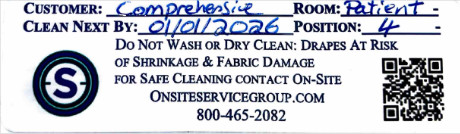
- Service records record last cleaning dates. Stickers on each drape indicate date of cleaning.
- Certificates issued showing NFPA testing/re-certification and flame-retardant application
- Electronic Tracking - Reminders set in On-Site Software to schedule next cleaning when due.
Timeline (Milestones)
- November: Pre-service: On-Site Assessment, Project Pricing, Confirmation of 11 panels.
- December: Service window (after hours): On-site cleaning/sanitization + repairs as needed, after-hours scheduling, sequencing by patient-area zones all returned to service before next clinic day
- December: Close-out: Invoice and documentation proving sanitization and flame testing compliance.
Results
- 11 panels in the main patient area cleaned and sanitized.
- No disruption to clinic operations: cleaning conducted outside clinic hours
- Reduced infection-control exposure risk: supports a repeatable curtain-maintenance program aligned to patient turnover, infectious-disease events, and scheduled intervals.
- Inspection-ready documentation: proof of sanitization plus NFPA certificates provided.